Ecosystems
Stellar Scaffold: how we built the developer toolkit
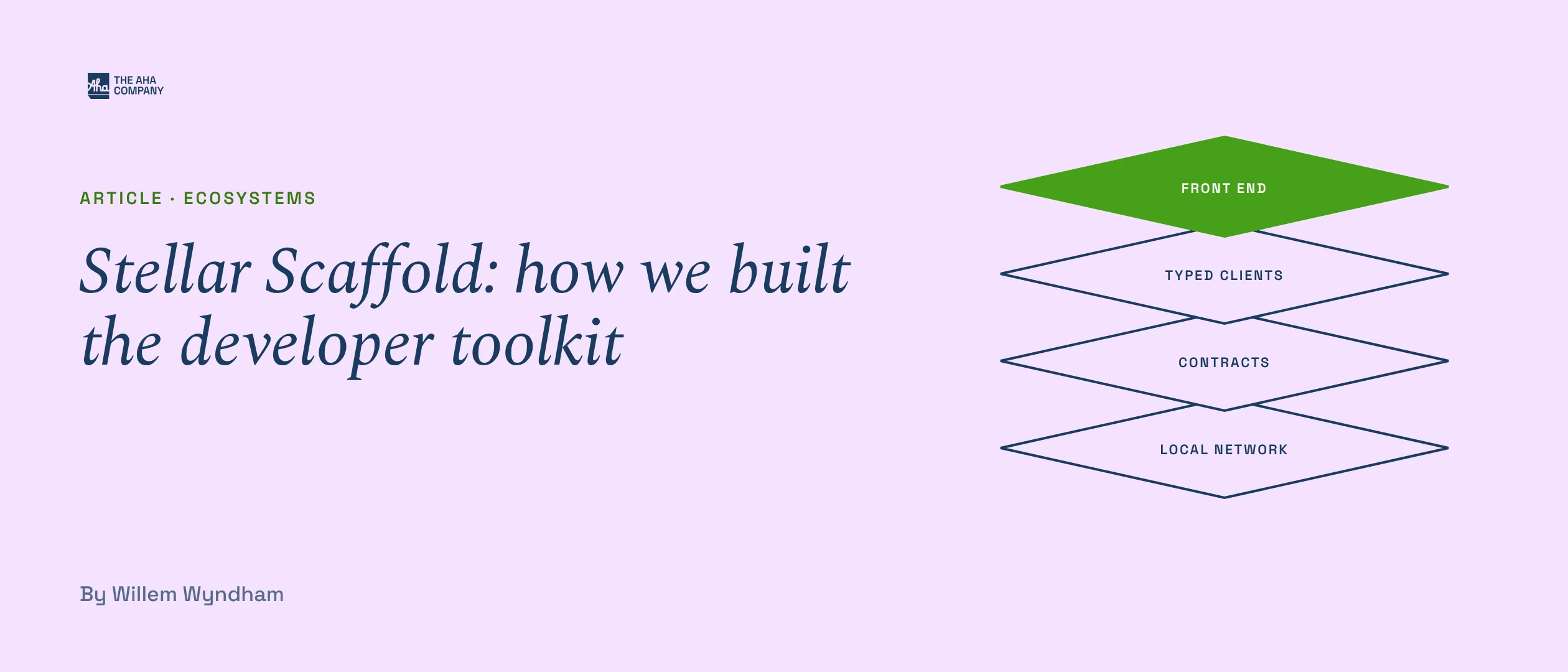
Stellar Scaffold takes a team from an empty folder to contracts, a web frontend, a local network and typed clients in one command. Why we built it as a Stellar CLI plugin, and what it took to make it production-grade.
The problem: a blank repository
When Soroban brought smart contracts to Stellar, every new project started the same way: write a contract, compile it to WebAssembly, deploy it to a local network, generate a client, wire that client into a frontend, and repeat on every change. Each step had a tool, and nothing joined them. A proof of concept spent its first week on plumbing.
Built on the Stellar CLI’s plugin system
We were already core contributors to the Stellar CLI, the network’s official command-line tool. One of the pieces we built there is its plugin system, which lets a separate tool run as a stellar subcommand. Stellar Scaffold is such a plugin, and it grew out of Loam, the tool we started in 2023. It reuses the CLI’s networks, keys and contract commands instead of reimplementing them, so a project behaves the same way on a laptop and on a public network.
What one command sets up
- Contracts, built and deployed in dependency order
- A web frontend in React or Svelte, wired to those contracts
- A local network running in Docker
- TypeScript clients generated from each contract’s interface, regenerated on every change
The other commands follow the life of the project: build, watch, generate, upgrade, and doctor, which checks a project’s setup.
Safe by default
Configuration lives per network, and secrets stay out of the repository. Deployment to a public network is locked unless the project explicitly allows it, so a demo cannot reach mainnet by accident. Contract templates come from OpenZeppelin: allowlist, blocklist and pausable tokens, the patterns a regulated issuer asks for on day one.
Release engineering
Stellar Scaffold ships for six platforms from one release pipeline, and every release comes with a software bill of materials. As of November 2, 2026, it has had 37 releases, and version 1.0 is in preparation.
Maintained as a public good
Stellar Scaffold is open source, listed in the official Stellar documentation and funded as a Stellar public good. On November 2, 2026, 111 projects built on it, and OpenZeppelin’s Contracts Wizard exports any Stellar contract as a Stellar Scaffold package. It runs on a quarterly proposal and review, which keeps it maintained, not merely released. Who builds on it, with every count dated, is on its tool page.
What it changes for a client
A client’s proof of concept starts from a reproducible, documented project instead of a blank repository. The same structure carries the project to testnet and then to mainnet, so the first week goes to the product, not the plumbing.

Architects of Stellar Scaffold and Stellar Registry.


