Open source · Developer tooling
Stellar Registry: an onchain package manager for smart contracts
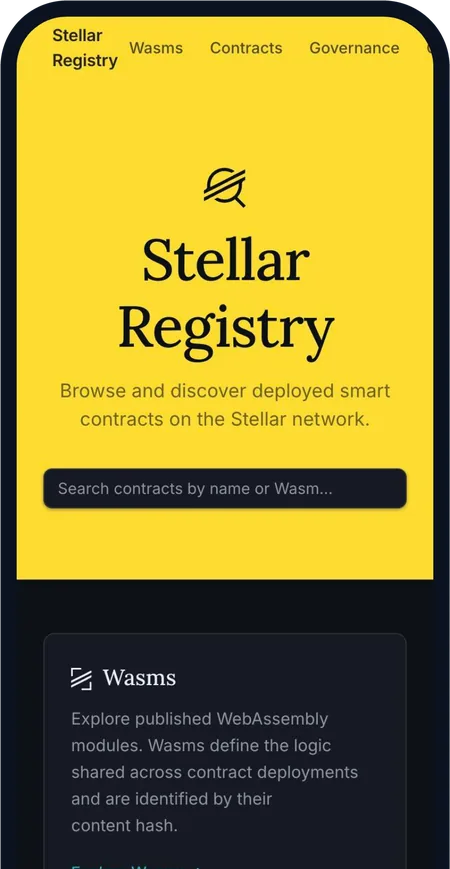
Publish a contract once, then deploy and import it by name on any network, instead of passing addresses around. The Stellar Registry is an onchain package manager for Soroban smart contracts. We designed, built and operate it, and Veridise audited it with no findings.
- Network
-
 Stellar
- Our role
- Designed, built and operated by us
- Audit
- Veridise, no findings (November 2025)
- Status
- On mainnet since July 2026
- Release
- Contract v0.8.0 (October 2026)
- Runs as
- A Stellar CLI plugin and rgstry.xyz
~/projects $ stellar registry --helpAdd, manage, and use Wasm packages & named contracts in the Stellar RegistryUsage: stellar-registry <COMMAND>Commands: account Name and manage accounts (G-addresses and smart accounts) create-alias Create a local `stellar contract alias` from a named registry contract current-version Get the current (latest) version of a published Wasm deploy Deploy a named contract from a published Wasm deploy-unnamed Deploy a contract from a published Wasm without registering a name download Download a Wasm binary, optionally creating a local file fetch-contract-id Look up the contract ID of a deployed contract by name fetch-hash Fetch the hash of a published Wasm binary publish Publish Wasm to registry with package name and semantic version…stellar registry, here in a real session (version 0.3.0, recorded on November 5, 2026).What it does
On Stellar, a contract is an address. Teams pass those addresses around in configuration files and messages, and every network has its own. The Registry gives contracts names. A developer publishes a contract’s code once, under a name and a version. Anyone can then deploy a named instance from it, or resolve a name to the contract it points to, from the command line, from Rust code or at runtime.
An issuer can run its own namespace and decide which contract version its name points to. Versions only move forward. Compromised entries can be flagged, and flagged entries are refused by default.
What we built
- The registry contract: a managed root, namespaces, and versions that only move forward.
- Safety controls: flagged entries are refused by default, and naming an account needs that account’s consent.
- Admin and upgrade rights through the contract admin standard we drafted with an engineer at the Stellar Development Foundation, governed by a security council on Tansu.
- The CLI plugin and Rust macros that import a contract or an asset by name, the rgstry.xyz interface and its indexer.
Who uses it
Contracts running code published in the Registry carry live mainnet traffic: 166,833 calls by October 31, 2026, calls made from other contracts included.
| Contract | What the calls do | Mainnet calls |
|---|---|---|
| kalien, an onchain game | Game transactions | 109,116 |
| RISC Zero Groth16 verifier | Zero-knowledge proof checks for other contracts | 53,233 |
| WebAuthn and Ed25519 verifiers, taken from the Registry by smart accounts | Passkey and key signature checks | 3,204 |
| Other published contracts: smol, ohloss, Perch and smart-account policies | Token launches, games and account policies | 1,280 |
| Total | 166,833 |
Call counts from StellarExpert. Contracts deployed before the Registry existed, such as KALE’s farm, are left out.
On mainnet, passkey-kit and smart-account-kit, both now in the Stellar Development Foundation’s GitHub organization, publish their contracts through the Registry, as do KALE, smol, ohloss, kalien and a RISC Zero verifier. On testnet, HackMeridian 2026 teams used it from the first day: ZBE TOLL published two versions of its contracts and resolves them by name, ancora names each organization’s treasury in the Registry, and Shake resolves Nido’s factory at runtime. Our own Nido, Perch, Tansu and Moonlight use it too.
Where it came from
The Registry grew out of SmartDeploy, which we started in 2023: its crate has 12,093 downloads since September 2023, and the Registry’s own crates 20,495 since May 2025 (crates.io, November 2, 2026). Like Stellar Scaffold, it is funded as a Stellar public good.


